Capture one live page session
A live page check records the state of one destination at one time. On 4 August 2026, the current Sapphire Blue Cigarettes – 1 Carton (10 Packs) detail page returned the complete title Sapphire Blue Cigarettes – 1 Carton (10 Packs), SKU SS-214, a displayed AUD amount of A$327.54 and an in stock state. This snapshot does not compare the item with another product. It documents the fields exposed by the current OPPuff page so a later check can identify exactly what changed.
Save the requested and final URL
Record both the URL requested and the destination that finally loaded. They should identify the same product page without an intermediate redirect chain. A search result, shared message or browser history entry may open a shortened route, so the final address belongs in the snapshot. This first step also prevents a reviewer from extracting fields from a category card while believing the product detail page is open.
Use a seven-field snapshot
The live page can be summarized without adding unsupported specifications:
| Snapshot field | Value observed |
|---|---|
| Final product URL | OPPuff Sapphire Blue product destination |
| Complete title | Sapphire Blue Cigarettes – 1 Carton (10 Packs) |
| SKU | SS-214 |
| Sale unit | 1 carton containing 10 packs |
| Displayed price | A$327.54 AUD |
| Stock state | in stock |
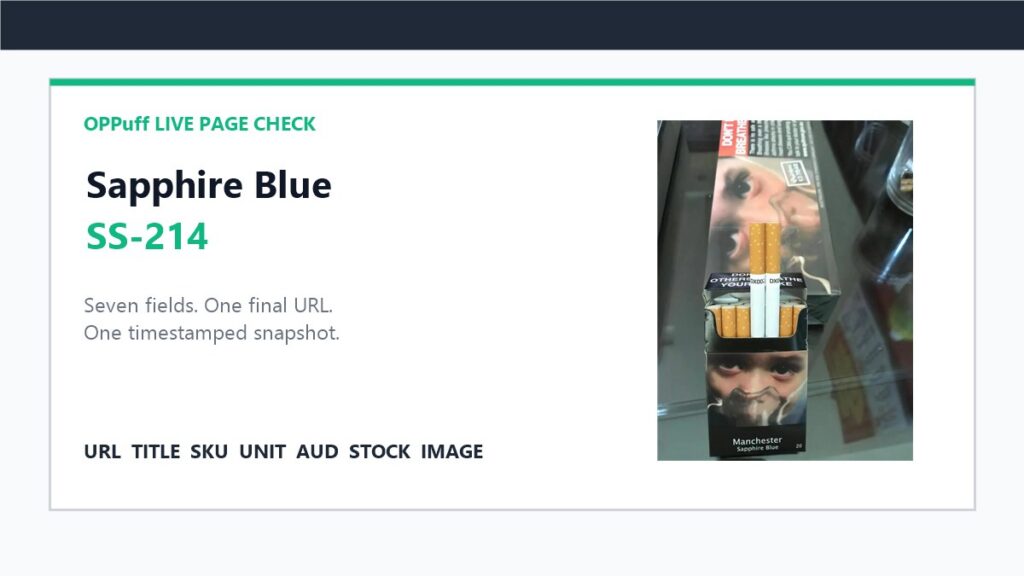
| Product image | Loaded from the current record |
Every row should be refreshed from the page instead of carried forward automatically.
Start broad in Shop
Use the OPPuff Shop when the session begins with a partial phrase. The Shop proves that the listing can be reached through the current catalogue and provides a route to its detail page. It may not display every identity field in the card. Open the destination before recording the full title, SKU or carton hierarchy, and do not treat the grid position as part of the product record.
Narrow with the Manchester route
The Manchester category shows the present navigation group for the product. That route can help distinguish the listing from unrelated catalogue families, but shared category membership does not make two records interchangeable. The category page is one step in the live route; the final SS-214 page remains the source for the seven-field snapshot.
Match title and SKU on the same page
The complete Sapphire Blue title and SS-214 must be visible as one identity pair. A partial name can retrieve several results, and an isolated SKU copied from another note can be stale. Record both from the same loaded destination. If either field is absent or differs, the session has reached a stopping condition and the remaining commercial fields should not be attributed to SS-214.
Read the unit before the amount
The title describes one carton containing 10 packs. Capture that hierarchy before writing the displayed price. Doing so prevents A$327.54 from being represented as a one-pack amount and avoids an unsupported derived price. The snapshot reports the product unit exactly as published. It does not calculate a different offer or assume that another listing uses the same carton structure.
Date the price and stock fields
Commercial fields answer what the page showed during the session, not what it will show later. The observed amount was A$327.54 in AUD and the state was in stock. Attach the date to both. When a future run produces a different value, append the new snapshot instead of silently replacing the old evidence. That creates a change history while keeping the identity pair stable.
Verify that the image actually loaded
Check that the featured product image request returned successfully, completed loading and has a non-zero natural width. The image can support the page record, but it cannot settle an identity conflict by itself. Cropping, replacement media and similar packaging can mislead a visual-only review. Title, SKU and final URL remain the stronger controls.
Keep a field-level change log
When the page changes, name the field. A title edit, SKU mismatch, price update, stock transition, image replacement and policy revision are different events. Recording them separately prevents one visible change from being described as a complete product change. It also gives the next reviewer a narrow question: which field moved, when was it observed and which current source now supports it?
Check delivery from its own page
Use the current Australian shipping policy for Australia-only scope and current destination conditions. A product being discoverable, priced and in stock does not answer a delivery question. Add the policy URL and review time to the snapshot, but keep its statements outside the identity table. This maintains a clear boundary between catalogue fields and delivery rules.
Check returns from its own page
The OPPuff returns and refunds policy is the source for return and refund processes. A live page checklist can confirm that the policy was accessible, yet it should not predict eligibility for an unplaced order. If a product field is wrong and a policy question also exists, document each issue separately so the evidence does not blend a listing mismatch with a requested remedy.
Send a precise page discrepancy
Use the contact page when the current page cannot resolve a conflict. Include the complete title, SS-214, final URL, session date and one description of the mismatched field. Avoid sending only a package image or a shortened product name. A precise note lets support reopen the same destination and compare the same seven fields.
Rerun the checklist in order
The order matters: load the destination, capture the final URL, match title and SKU, read the carton unit, date price and stock, verify the image and then review policies. Repeating that sequence reduces the chance that a later field will be attached to the wrong record. It also makes desktop and mobile observations comparable because both sessions use the same field list.
Apply clear stop conditions
Stop when the destination changes product, the title and SKU no longer agree, the carton wording is absent, or a remembered value is being used instead of the loaded page. A stop is not a product judgement. It is a signal that the current session lacks enough reliable page evidence to complete the SS-214 snapshot.
Related OPPuff reading
OPPuff Live Page Checklists already includes general articles on initial checks, workflow and audit errors. This Sapphire Blue entry adds a seven-field session record for one live destination. Its purpose is to extend the journal with a concrete page snapshot rather than repeat the existing general checklist language.
Adult catalogue notice
OPPuff publishes this page-check reference for Australian adults aged 18 and over. Nicotine is addictive and smoking carries serious health risks. The snapshot is not medical advice, a suitability claim or a guarantee concerning inventory, price, shipping, returns or order acceptance.
Common questions
Which record did the seven-field snapshot cover?
It covered Sapphire Blue Cigarettes - 1 Carton (10 Packs), identified on the current OPPuff page by SKU SS-214.
What are the seven live page fields?
Record the final URL, complete title, SKU, carton unit, displayed AUD price, stock state and loaded product image.
Can a Shop card replace the product detail page?
No. The card is a discovery route; the final detail page is required for the complete title, SKU and product-level snapshot.
Does an in stock label guarantee later availability?
No. It describes the page state observed during this session and must be checked again before relying on a later catalogue record.